The Cain Complex: How Modern Culture Rebuilt the Tower of Babel
Modern tech-utopianism and religious dominionism share an ancient root: the Cain Complex. Explore how self-deification is rebuilding the Tower of Babel.

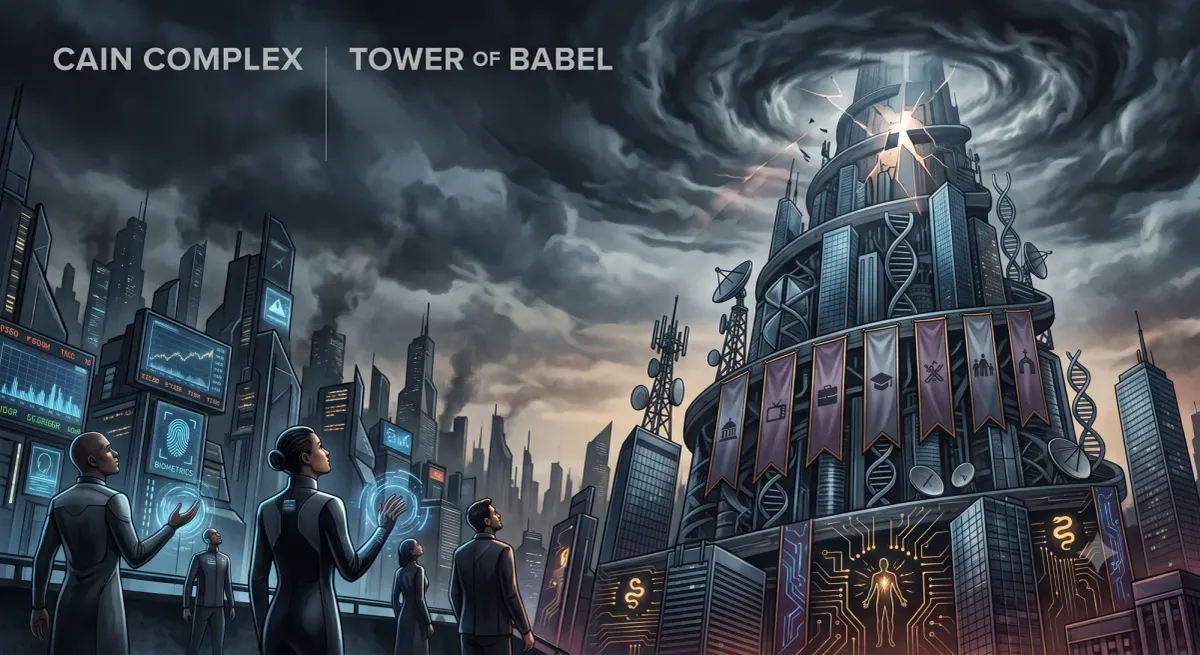
If you look closely at the world today, a strange pattern emerges: we are technically brilliant, immensely powerful, and deeply anxious. We break records in innovation every year, yet trust in our shared institutions and morals is at an all-time low.
This isn't a new story. In fact, Solomon captured it perfectly: "There is nothing new under the sun" (Ecclesiastes 1:9).
Long before modern algorithms, transhumanism, or political power plays, ancient texts laid down a blueprint for what happens when human beings reject transcendent authority and try to save themselves.
From the Genesis narrative of Cain to the Tower of Babel, history reveals a repeating cycle: when we refuse to submit to God on His terms, we don't stop worshipping—we just deify ourselves.
1. The Lineage of Cain: High Technology, Zero Transcendence
In Genesis 4, Cain commits history's first murder and is banished to the land of Nod—a word that literally means "wandering" or "restlessness." Cain doesn't go off to die in a cave; he builds the world's first city.
His descendants quickly become masters of civilization:
- Enoch constructs urban infrastructure.
- Jabal masters livestock management.
- Jubal invents musical instruments.
- Tubal-Cain becomes a master of metallurgy and weaponry.
Notice something striking about Cain’s family tree? They are remarkably creative and technologically advanced. Yet, across generations, not a single descendant of Cain is recorded as praying, building an altar, or seeking God.
Instead, human capability quickly outpaces morality. By the time we reach Lamech (five generations down), he uses metal weaponry to murder a young man over a minor insult, boasting that he is seventy-seven times more powerful than God’s protection.
2. The Great Swap: Trading Atonement for "Gnosis" and Self-Deification
When a society decides it no longer needs a transcendent Creator, it faces a massive psychological problem: What do we do about suffering, guilt, and death?
In traditional Christian theology, humanity’s primary problem is sin (alienation from God), and the only cure is the Atonement—admitting our limitations, repenting, and receiving grace through Christ’s finished work on the cross.
When you throw out the Atonement, the human need for redemption doesn't disappear. Instead, we invent secular and spiritual counterfeits:
| The Biblical Paradigm | The Secular / Self-Deified Paradigm |
| Problem: Sin and moral brokenness | Problem: Ignorance, lack of power, and biology |
| Savior: Jesus Christ | Savior: The Self, tech elites, or anointed leaders |
| Means: Repentance & Grace | Means: Tech innovation, specialized knowledge, & authority |
| Hope: Resurrection & Eternal Life | Hope: Physical/digital immortality & earthly dominion |
This mindset borrows heavily from ancient Gnosticism—the belief that physical nature is an oppressive trap, and that humans are saved by acquiring specialized, elite knowledge (gnosis) to unlock their own inner divinity. Modern tech-utopianism—with its promise that we can cure death with code, master genetic engineering, and achieve digital immortality—is simply Gnosticism wrapped in silicon.
Gnosticism and Early Christianity
Many Gnostic movements arose within early Christianity. In these specific sects, Jesus Christ was viewed not primarily as a savior from sin through his crucifixion, but as a divine emissary who came to earth to reveal this secret, liberating knowledge (gnosis) to the chosen few. Mainstream (proto-orthodox) Christianity ultimately rejected these teachings as heretical, leading to the suppression of Gnostic groups and the loss of their writings for centuries.
Modern Example 1: The "Manifest Sons of God" Teaching
This ancient Gnostic impulse toward self-deification isn't just found in Silicon Valley; it has subtly infiltrated modern religion through teachings within the New Apostolic Reformation (NAR).
A prime example is the Manifest Sons of God doctrine (a core historical stream of NAR theology rooted in the Latter Rain movement). This teaching asserts that an elite end-times company of believers will attain such spiritual perfection and supernatural authority that they become full, bodily "gods" on earth—conquering biological sickness, defeating physical death, and executing divine judgment before Jesus returns.
Instead of salvation being centered on Christ’s unique incarnation and His finished Atonement, human beings are effectively deified. The human vessel becomes the center of power. Just as Gnosticism promised that secret spiritual knowledge unlocks the divine spark within us, "Manifest Sons" theology promises that tapping into specialized "apostolic revelations" and "anointings" will transform humans into divine agents on earth. It is the age-old serpent's lie from the Garden: "You will be like God" (Genesis 3:5).
3. Rebuilding Babel in the Modern World
In Genesis 11, humanity gathers on the plain of Shinar with a single objective: "Come, let us build ourselves a city and a tower with its top in the heavens, and let us make a name for ourselves..."
Modern Example 2: The European Parliament Tower of Babel in Strasbourg

For critics of the European Union, the deliberate "unfinished" design of the Louise Weiss building in Strasbourg feels less like modern art and more like a stark piece of unintended irony. Skeptics frequently compare its jagged top and spiraling layout to Pieter Bruegel’s famous 16th-century depiction of the Tower of Babel—the biblical symbol of overreaching human ambition that ultimately collapsed under the weight of its own language barriers and hubris. To political commentators and euroskeptics, the architectural mirror isn't just a coincidence; it's a visual metaphor for a bureaucratic system attempting to unite dozens of distinct cultures and languages under a single, sprawling roof, constantly teetering on the edge of its own overextension. Visit the European Parliament website.
The Original Promotional Poster of the European Union
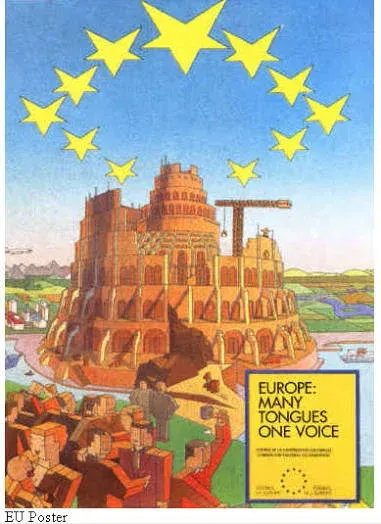
In addition to the architecture itself, a 1992 official Council of Europe promotional poster sparked immense controversy by explicitly leaning into the biblical imagery. The poster featured a graphic illustration directly inspired by Pieter Bruegel’s The Tower of Babel, depicting a colossal, uncompleted tower surrounded by modern construction cranes.
Accompanied by the official motto, "Europe: Many Tongues, One Voice," the imagery was intended by European officials to celebrate multilingualism and unity across diverse cultures. However, the campaign backfired among critics and religious commentators, who argued that invoking the very symbol of human defiance against God—alongside upside-down star motifs—sent an inadvertently dystopian message about overreaching global ambition. The backlash was severe enough that the poster was eventually withdrawn, though it remains a legendary focal point in discussions of EU symbolism. Visit the Council of Europe website.
Modern Example 3: "Kingdom Now" Dominionism and the 7 Mountain Mandate
Today, we see this exact "Babel impulse" played out in the NAR's expression of "Kingdom Now" Dominionism, specifically through the Seven Mountain Mandate (7MM).
Kingdom Now theology teaches that Jesus cannot return until the Church—led by modern-day "Apostles and Prophets"—takes absolute spiritual, physical, and political control over all earthly institutions. This doctrine is described as Post Millenialism. The 7MM explicitly outlines this as conquering seven key pillars of society: Government, Media, Business, Education, Arts/Entertainment, Family, and Religion.
Contrast this with the humble, cross-bearing servant leadership taught by Jesus, who explicitly declared: "My kingdom is not of this world" (John 18:36).
Where Jesus modeled sacrificial love and pointed toward an eternal Kingdom established by His return, Kingdom Now Dominionism re-enacts the Tower of Babel:
- The Goal: Build a top-down, humanly managed empire of cultural and political conquest.
- The Motive: Establish centralized earthly authority and "make a name" for an elite apostolic network.
- The Shift: Replacing the call to proclaim the gospel of repentance with a mandate to seize social power.
4. The Apex of Deification: Authoritative Restructuring & Modern Prophets
To truly understand how deep the deification of man runs in the NAR, one must look at how local churches and leaders are being pressured to restructure their governing authority.
The NAR claims that God is actively restoring the offices of "Apostle" and "Prophet" to rule over the global Church—claiming that pastors, churches, and individual believers must bring themselves into direct "alignment" with self-appointed Apostles who hold supreme governing power.
Modern Example 4: Absolute Human Rule and Extra-Biblical Revelation
This dynamic places human leaders into a role that belongs solely to God and His written Word:
- Self-Appointed Apostles: Local elderships and congregational bodies are displaced in favor of regional or global "Apostles" who claim authority over local churches. To question or disobey these leaders is framed as rebelling against God Himself. The leader essentially becomes an infallible proxy for God.
- Self-Appointed Prophets & Direct Revelation: Modern NAR prophets claim to receive "fresh," direct words from God that believers are expected to obey blindly. Instead of Scripture being the sufficient and final rule for life and faith, believers become dependent on human mouthpieces for "divine instruction".
They want to be seen as God-men who rule and reign over their subjects. They are proud and arrogant. True spiritual leaders are first and foremost servants of Christ, and shepherds of His flock. They are expected to lay down their lives for the flock they oversee, rather than dominating and fleecing them for personal gain and self-aggrandizement.
The Biblical Contrast: Foundational vs. Modern Claims
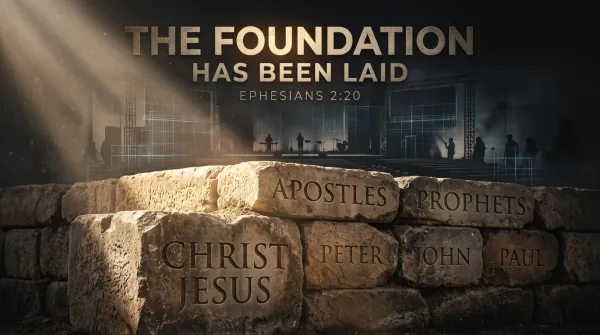
This restructuring directly contradicts the biblical design of the Church. In Scripture, the true apostles and prophets served a specific, foundational role. As Paul writes in Ephesians 2:20, the Church is "built on the foundation of the apostles and prophets, Christ Jesus himself being the chief cornerstone."
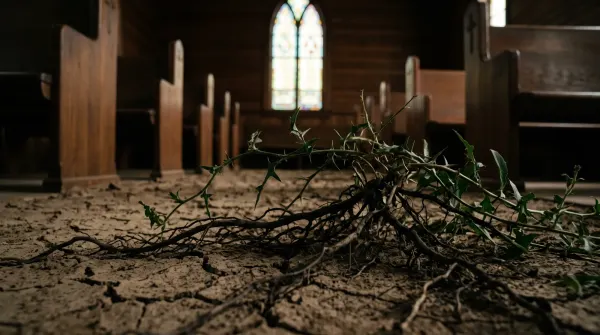
When modern leaders claim to reinstate these offices to wield supreme authority and issue extra-biblical decrees, they are not reviving biblical Christianity. They are placing human beings on a pedestal of absolute power, demanding the kind of unquestioning allegiance that belongs to Christ alone. It is the ultimate manifestation of the Cainite spirit inside the church building: substituting human authority for divine revelation. Anything that does not elevate Christ in the Church is a falsehood designed to elevate man, and the motive for this is pride.
Jesus is the Apostle and High Priest of our confession
"Therefore, holy brethren, partakers of the heavenly calling, consider the Apostle and High Priest of our confession, Christ Jesus .." Hebrews 3:1
Jesus is the Prophet through whom God speaks today
"God, who at various times and in various ways spoke in time past to the fathers by the prophets, has in these last days spoken to us by His Son, whom He has appointed heir of all things, through whom also He made the worlds ..." Hebrews 1:1-3
Jesus is the Word and speaks to us through it
The Bible connects Jesus to "the Word" by identifying Him as the exact physical expression of God's nature and will (John 1:1, 14). Today, God primarily speaks to us through His written Word (the Bible), illuminated by the Holy Spirit, and through the living example of Jesus Christ.
Key Takeaways
- The "Cain Complex": Ancient history shows that rejecting God doesn't stop worship—it leads to self-deification. Cain’s lineage built a technologically advanced civilization that ultimately relied on human power instead of divine grace.
- The Modern Gnostic Swap: Rejecting Christ’s Atonement forces culture to create secular and spiritual counterfeits, trading repentance for "gnosis" (specialized knowledge) and the pursuit of self-directed immortality.
- Rebuilding Babel via Dominionism: The ancient urge to build a name and system apart from God is mirrored today in "Kingdom Now" Dominionism and the Seven Mountain Mandate, which seek earthly cultural conquest rather than humble service.
- Restructuring Church Authority: Modern claims restoring the supreme offices of "Apostles and Prophets" replace the sufficient, finished Word of God with extra-biblical revelation and unquestioning loyalty to human leaders.
- The Foundation Remains: True biblical Christianity rests on the foundational, completed work of the original eyewitness apostles and Christ alone—not on human-built towers or self-appointed authorities.
When we make human wisdom or human authority the apex of reality, we inevitably turn ourselves into our own idols. We build brilliant tools and spiritual systems that scale our power, but without a transcendent moral anchor rooted in the sufficiency of Scripture, those systems eventually consume us.
True salvation isn't found in building higher towers, acquiring "little god" status, or submitting to self-appointed apostles claiming supreme earthly control. It starts with the radical humility to admit that we are not gods—and that the only Kingdom that lasts is the one Christ established on the cross, not the ones we try to build for ourselves.
Seeing any of these red flags in your own congregation? Reach out to us here.
Action Steps:
- Check the Glossary: Visit our NAR Glossary to see if your church is using these redefined terms.
- Compare the Claims: Read our 10 Signs of Church Drift to see if these patterns exist in your congregation.
- Subscribe: Don't Miss a Single Reveal! The unmasking is just beginning. Join over 1,000+ watchmen who receive these deep dives directly in their inbox.
This research is 100% viewer-supported. If this article helped you, consider partnering with our mission to help us keep the lights on.