THE FOUNDATION PROBLEM: Why Ephesians 2:20 Matters for Modern Apostles
Foundational structures are laid once, not repeatedly rebuilt every generation. In Part 2 of our investigation into Four12's apostolic authority, we examine Ephesians 2:20 and ask a crucial question: If the apostolic foundation has already been laid, what exactly are modern apostles laying?

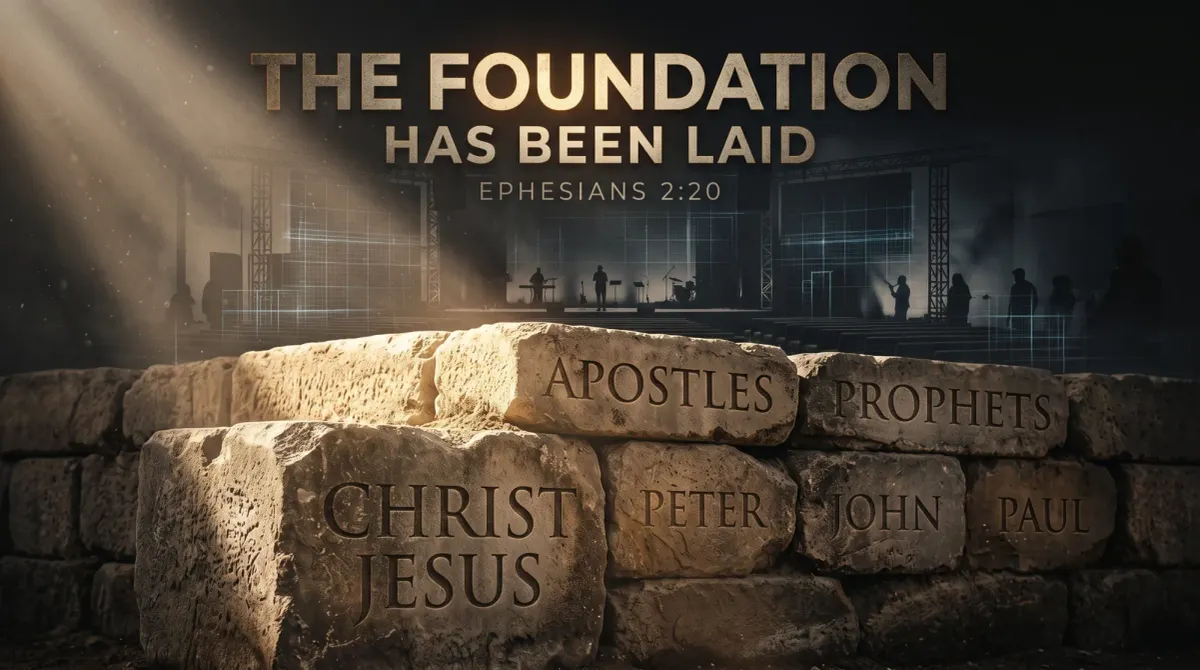
Part 2 of the Four12 Apostolic Authority Investigation

The Question Behind the Question
In Part 1 of this investigation, we examined Four12's appeal to Ephesians 4:11 as biblical support for modern apostles.
Four12 does not hide its position. Its published material teaches that apostles remain important to the Church today and that present-day apostles, while different from the original apostles, continue to exercise an apostolic ministry. Four12 describes apostolic ministry as something that helps build churches according to biblical foundations and describes apostles as servants involved in church governance and partnership with local elders.
But there is a more fundamental question.
What does the New Testament mean when it says that the Church is built on the foundation of the apostles and prophets?
Paul writes:
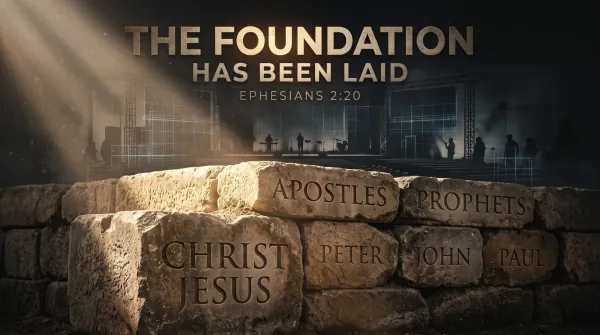
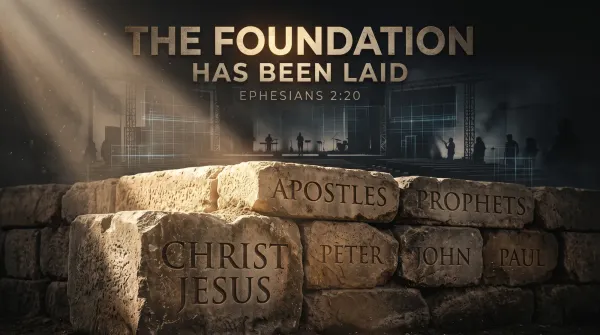
“Built on the foundation of the apostles and prophets, Christ Jesus himself being the cornerstone.”
— Ephesians 2:20
That statement creates a serious theological problem for any doctrine of a continuing apostolic office.
Because foundations are not normally laid repeatedly.
They are laid once.
The question, therefore, is not simply whether apostles appear in Ephesians 4:11.
The question is whether the apostles described there are part of the foundational ministry of the New Testament Church, or whether Paul intended to establish a permanent class of translocal church rulers whose office would continue throughout church history.
That distinction matters enormously.
What Is a Foundation?
Imagine constructing a building.
The foundation establishes the structure's position, stability and alignment.
Once the foundation has been laid, subsequent builders do not normally return to the site every generation and lay another foundation.
They build upon it.
Paul uses precisely this kind of language in 1 Corinthians 3.
“According to the grace of God given to me, like a skilled master builder I laid a foundation, and someone else is building upon it.”
— 1 Corinthians 3:10
Paul does not say:
“I am one of a continuing class of master builders who will repeatedly lay new apostolic foundations.”
He says that he laid a foundation and that others are building upon it.
Then he immediately identifies that foundation:
“For no one can lay a foundation other than that which is laid, which is Jesus Christ.”
— 1 Corinthians 3:11
The implication is important.
There is a distinction between laying the foundation and building upon the foundation.
Ephesians 2:20 Uses Foundation Language Deliberately
Ephesians 2:20 is not merely describing apostles as especially influential Christian leaders.
Paul uses architectural language.
The Church is pictured as a building.
Christ is the cornerstone.
The apostles and prophets belong to the foundation.
And the rest of the structure is built upon that foundation.
This raises a critical question:
If apostles are foundational to the Church, what exactly are modern apostles laying?
There are only a few possibilities.
Possibility One: They Are Laying a New Foundation
If modern apostles are actually laying another apostolic foundation, that would appear to conflict with Paul's statement that another foundation cannot be laid.
The foundation is Christ.
The apostolic and prophetic witnesses belong to the foundational structure through which the New Testament Church was established.
A new foundation would therefore require extraordinary biblical justification.
Possibility Two: They Are Not Laying a New Foundation
If modern apostles are not laying a new foundation, then another question follows:
In what sense are they apostles?
They may be church planters.
They may be missionaries.
They may be teachers.
They may provide leadership to churches.
They may travel internationally.
They may help churches cooperate.
All of those activities can be valuable.
But none of them, by themselves, establishes the existence of a New Testament apostolic office.
Four12 Acknowledges a Difference
This is where Four12's own teaching becomes particularly important.
Four12 openly acknowledges that present-day apostles differ from the original apostles of the New Testament. Its “Unpacking the Apostolic” material specifically asks what qualifies present-day apostles and how they differ from the original apostles.
That distinction is intellectually honest.
But it creates another question:
Where does Scripture establish this second category of apostle?
If the original apostles were foundational, but modern apostles are different, the biblical case cannot simply assume that the word apostle automatically establishes the same office.
The difference itself has to be demonstrated.
The Foundation Was Connected to Witness
The New Testament gives us an unusually significant example in Acts 1.
After Judas's death, the apostles sought someone to replace him.
Peter did not propose:
“Let's find someone who demonstrates exceptional leadership ability.”
Instead, the candidate needed to have accompanied Jesus' disciples throughout His earthly ministry and become a witness of His resurrection.
The requirement was extraordinarily specific.
The apostolic foundation was connected to eyewitness testimony of Christ.
That makes sense.
The apostles were not merely administrators.
They were witnesses to the historical Jesus and His resurrection.
Their testimony became foundational to the Church.
Paul's Apostleship Was Also Extraordinary
Paul was not one of the Twelve.
That is important because the argument cannot simply be reduced to:
“Only the original Twelve could be apostles.”
Paul was unquestionably an apostle.
But notice how Paul describes his own apostleship.
“Am I not an apostle? Have I not seen Jesus our Lord?”
— 1 Corinthians 9:1
And in Galatians 1:1:
“Paul, an apostle—not from men nor through man, but through Jesus Christ and God the Father.”
Paul's apostleship was not simply a title conferred by an organizational leadership team.
His authority was rooted in a divine commissioning connected with Christ Himself.
That makes the modern question unavoidable.
What is the biblical basis for someone today possessing the office of apostle without the defining circumstances associated with the foundational apostles?
“But Modern Apostles Are Different”
This is perhaps the most important distinction in the entire investigation.
If someone says:
“Modern apostles are exactly the same as Paul and Peter,”
then the biblical qualifications and evidence become unavoidable.
But if someone says:
“Modern apostles are different from the original apostles,”
then the question becomes:
Where does the New Testament establish this different office?
The answer cannot simply be Ephesians 4:11.
Why?
Because the verse says Christ gave apostles, prophets, evangelists, pastors and teachers.
It does not explicitly explain:
- how long each office continues;
- whether each office continues in precisely the same form;
- whether modern apostles possess translocal governmental authority;
- how modern apostles are qualified;
- who has authority to recognize them;
- who can remove them;
- what signs distinguish them;
- or how their authority relates to the unique authority of the first-century apostles.
Those questions require further biblical argument.
The Foundation Is Not a Lesser Form of Apostolic Authority
Another important point must be made.
The foundation does not become irrelevant simply because it was laid in the past.
Quite the opposite.
The foundation remains authoritative precisely because it has already been laid.
Christ does not need to be replaced.
The apostles do not need to be reinvented.
The New Testament does not need another foundational generation.
The Church needs faithful builders who remain aligned with the foundation already given.
This distinction is crucial.
There is nothing wrong with saying that churches need people who plant churches, establish doctrine, train leaders, strengthen congregations and work across national boundaries.
The question is whether those functions require the office of apostle.
Building on the Foundation Is Not the Same as Laying It
Paul's analogy gives us an important framework.
One person lays the foundation.
Others build upon it.
The later builders are not less important because they are not foundation layers.
They are responsible for building faithfully.
That is precisely why Paul warns:
“Let each one take care how he builds upon it.”
— 1 Corinthians 3:10
The warning is not:
“Make sure you become another apostle.”
The warning is:
Build carefully on the foundation already given.
That changes how we should approach modern church leadership.
The crucial question becomes not:
“Where are today's apostles?”
but:
“Are today's leaders faithfully building upon the apostolic foundation already laid?”
What Does Four12 Mean by Apostolic?
Four12's own material describes apostles as crucial to building healthy churches. Its published material says the apostolic helps churches remain aligned with biblical foundations and describes apostles as servants rather than masters.
There is much in that language that sounds unquestionably Christian.
Of course churches need biblical foundations.
Of course leaders should serve rather than dominate.
Of course churches need accountability.
The issue is not whether those goals are good.
The issue is whether the title and office of apostle are necessary to accomplish them.
That distinction must not be blurred.
The Foundation Problem
The biblical evidence therefore presents a problem for any doctrine of continuing apostleship.
If apostles belong to the foundation of the Church, then the burden of proof rests on those who claim that another class of apostles continues to exercise an apostolic office today.
They must demonstrate from Scripture:
- What kind of apostles continue?
- How are they distinguished from foundational apostles?
- Where does Scripture establish this distinction?
- What authority do they possess?
- Who is accountable to them?
- Who tests them?
- What qualifies them?
- What prevents the office from becoming a source of unchecked authority?
These are not hostile questions.
They are biblical questions.
The New Testament itself teaches Christians to test those who claim spiritual authority.
The Foundation Has Already Been Laid
The Church does not need a new apostolic foundation.
Christ is still the cornerstone.
The apostolic witness remains in Scripture.
The gospel remains the gospel.
The New Testament remains the authoritative apostolic testimony preserved for the Church.
The issue is therefore not whether Christians need leadership.
They do.
The issue is whether Christians need a continuing office called apostle, possessing translocal authority over churches.
That is a much larger claim.
And it deserves much more than an appeal to Ephesians 4:11.
The Question We Take Into Part 3
If modern apostles are genuinely apostles, what should we expect to see?
Paul gives us an important clue.
He speaks of:
“the signs of a true apostle”
— 2 Corinthians 12:12
That statement is often minimized or explained away.
But if Paul himself identifies recognizable evidence associated with genuine apostleship, we need to examine exactly what he meant.
What were the “signs of a true apostle”?
And what happens when those signs are applied to claims of modern apostolic authority?
That is the question we will examine in Part 3.
**The foundation has been laid.
The next question is whether the biblical marks of apostleship are still present.
The next post in this series will explore SIGNS OF A TRUE APOSTLE: What 2 Corinthians 12:12 Actually Says
Action Steps:
Subscribe: Join with other watchmen who receive these deep dives directly in their inbox.
This research is 100% viewer-supported. If this article helped you, consider partnering with our mission to help us keep the lights on.