The Forgotten Battle for the Cosmos: Why Irenaeus’s "Against Heresies" Still Matters
In the late 2nd century, an esoteric movement called Gnosticism threatened to fracture the early Church. One pastor, Irenaeus of Lyons, stepped up to drag their secrets into the light. This is a deep-dive analysis of his foundational masterwork, Against Heresies.
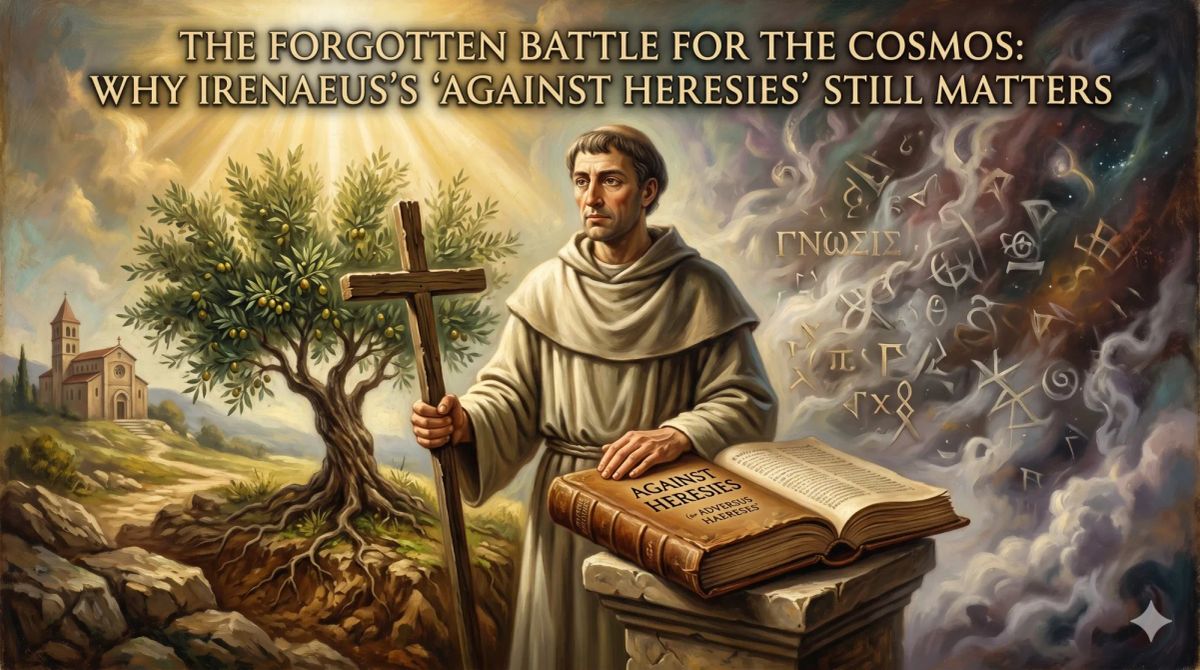
Imagine living in a world where the physical universe is not a masterpiece of a loving Creator, but a tragic cosmic mistake. Imagine a faith where salvation isn’t found in love, community, or grace, but in a secret, multi-layered cosmic puzzle that only an elite few possess the intellectual keys to unlock.
In the late second century, this wasn't a sci-fi plotline. It was the dominant alternative reality threatening to swallow the early Christian Church whole.
The movement was called Gnosticism, and it was spreading like wildfire through the Roman Empire. Its teachers were charismatic, its mythologies were intoxicatingly complex, and its philosophy felt sophisticated. Christian communities were fracturing. The very identity of the faith was on the line.
Then came Irenaeus of Lyons.
Around 180 AD, this pastor and theologian penned a massive, five-volume masterwork officially titled Refutation and Overthrow of Knowledge Falsely So-Called—known to history simply as Against Heresies. It didn't just defeat the Gnostics; it laid the theological tracks that orthodox Christianity has run on for nearly two millennia.
Grab a cup of coffee. Today, we are doing a deep dive into the text, the tactics, and the timeless brilliance of Irenaeus's magnum opus.
1. The Enemy at the Gates: The Gnostic Threat
To understand why Irenaeus wrote with such fiery urgency, we have to look at what he was fighting. Gnosticism wasn't a single church; it was a loose network of esoteric sects, with leaders like Valentinus and Marcion pulling massive followings.
While their mythologies varied wildy, they held a few core tenets that fundamentally inverted Christian teaching:
- The Evil Creator: They believed the material world was inherently corrupt. Therefore, the Supreme God could not have made it. Instead, it was botched together by an inferior, arrogant, or outright evil lesser deity called the Demiurge (often identified with the God of the Old Testament).
- The Secret Spark: Human beings are mostly physical meat-suits, but a select few contain a trapped "divine spark" of the true spiritual realm.
- Salvation via Gnosis: You aren't saved by faith, repentance, or the cross. You are saved by gnosis (secret, esoteric knowledge). Christ was a cosmic messenger sent to whisper the passwords and secret handshakes required for your divine spark to escape the physical body and float back to the spiritual realm.
- The Phantom Jesus: Because matter is evil, the Gnostics claimed Jesus didn't actually have a physical body. He only appeared to be human (a heresy called Docetism). He didn't really suffer, bleed, or rise from the dead.
If the Gnostics won, Christianity would have mutated into an elitist, anti-physical, mystical philosophy. Enter Irenaeus.
2. Walking Through the Five Books
Irenaeus was a brilliant strategist. He knew that the Gnostics thrived on secrecy and mystique. His master plan was simple: expose them, reason against them, and then construct the true apostolic faith. Here is how Against Heresies unfolds across its five distinct volumes.
Book 1: Dragging Secrets into the Light
Irenaeus starts with a brilliant psychological insight: once a secret is exposed, it loses its power. He spends the entirety of Book 1 meticulously detailing the bizarre, convoluted cosmologies of the Gnostics—specifically the Valentinians. He maps out their "Pleroma" (the divine realm) filled with dozens of pairs of divine emanations called "Aeons" with names like Depth, Silence, Mind, and Truth. He describes how a cosmic mishap involving an Aeon named Sophia (Wisdom) accidentally resulted in the birth of the physical world.
By laying these secret doctrines bare in plain daylight, Irenaeus makes them look utterly ridiculous to the average reader. He famously compares Gnostic interpretation of scripture to someone taking a beautiful mosaic of a king, tearing the tiles apart, and rearranging them into the shape of a dog or a fox, all while claiming it’s the original picture.
Book 2: The Philosophical Takedown
Having exposed their myths, Irenaeus uses logic and common-sense philosophy to dismantle them. He attacks the idea of the Demiurge. If the Supreme God is infinite, all-powerful, and fills all things, how can there be an entire physical universe existing outside of Him that He didn't create or control?
He demonstrates that Gnosticism is internally inconsistent, intellectually lazy, and heavily plagiarized from pagan philosophers like Plato and Pythagoras.
Book 3: The Pillars of Truth (Scripture and Tradition)
With the Gnostic system in ruins, Book 3 shifts to building the orthodox defense. This is arguably the most historically vital book in the collection. How do we know what the true faith actually is if everyone claims to have the "real" version? Irenaeus introduces two massive concepts:
- Apostolic Succession: The Gnostics claimed Jesus whispered secrets to a few chosen disciples. Irenaeus counters that the true teachings of Jesus were public. The Apostles openly handed down their teachings to the bishops they appointed to lead the churches, who handed them to the next generation.
- The Fourfold Gospel: While Gnostics were forging new texts left and right (like the Gospel of Thomas), Irenaeus is the first church father to declare that there are exactly four Gospels—Matthew, Mark, Luke, and John. He beautifully argues that just as there are four zones of the world and four principal winds, it is natural that the Church should have four pillars holding up the truth.
Book 4: The Unity of the Testaments
One of the most dangerous Gnostic ideas (championed by Marcion) was that the God of the Old Testament was a wrathful monster, totally separate from the loving Father of Jesus.
In Book 4, Irenaeus uses the direct words of Jesus to prove that the God of Abraham, Isaac, and Jacob is the exact same God Jesus called Father. He introduces the concept of progressive revelation—salvation history is a grand, unfolding narrative. The Old Covenant wasn't a mistake; it was an educational tool, preparing humanity step-by-step for the arrival of the Messiah.
Book 5: The Redemption of the Dirt
The final book tackles the Gnostic hatred of physical matter. Irenaeus mounts a passionate, poetic defense of the physical resurrection of the flesh.
If God created the dirt, the dirt is good. If Jesus took on a physical body of flesh and blood, then flesh and blood are capable of being redeemed. Irenaeus argues that salvation is not an escape from the body, but the ultimate resurrection and transformation of the body. He finishes the book with a grand vision of the end times, emphasizing the literal, physical renewal of the entire creation.
3. The Theological Masterpieces
If you want to understand the heartbeat of Irenaeus's theology, you have to look at his two most revolutionary concepts. These aren't just dry doctrines; they are breathtaking visions of reality.
Recapitulation: The Ultimate Cosmic Re-Do
Irenaeus’s most famous theological contribution is the concept of Recapitulation (in Greek, Anakephalaiosis).
He argues that when humanity fell in the Garden of Eden, human history got derailed. We became enslaved to sin and death. To fix this, Jesus didn't just shout down instructions from heaven; He became a human being to re-live and re-do human history perfectly.
Jesus is the "New Adam." Where the first Adam faced temptation in a garden and failed through disobedience, Jesus faced temptation and succeeded through perfect obedience. Where Adam brought death through a tree (the Knowledge of Good and Evil), Christ brought life through a tree (the Cross).
Irenaeus writes that Jesus passed through every stage of human life—infancy, youth, and adulthood—sanctifying every age of human existence, absorbing our broken history into Himself, and rewriting the human story from the inside out.
Divinization (Theosis)
Because Irenaeus viewed humanity as inherently good but unfinished, he saw salvation as an ongoing transformation. He penned a sentence that would become the foundation for Christian mysticism and Eastern Orthodox theology for centuries:
"Through His transcendent love, our Lord Jesus Christ became what we are, that He might bring us to be even what He is Himself."
To Irenaeus, salvation is more than a legal transaction where your sins are wiped away. It is an organic, intimate union with the divine. God became human so that humans could become filled with the divine life of God, achieving immortality and incorruptibility.
4. Why Irenaeus Matters in the 21st Century
It is easy to look at Against Heresies as an ancient artifact—a dusty relic of a fight over long-forgotten myths. But if you look closely at modern culture, Neo-Gnosticism is everywhere.
We see it when people talk about their bodies as mere "meat-suits" or biological prisons, implying that their "true self" is entirely digital, psychological, or spiritual. We see it in the modern "spiritual but not religious" movement, which echoes the Gnostic disdain for historical community, accountability, and apostolic continuity in favor of a hyper-individualized, private enlightenment. We see it in our cultural obsession with secret, hidden cabals and "alternative facts" that promise an elite insider status.
Against all of this, Irenaeus still speaks.
He reminds us that this physical world—the dirt under your feet, the rain on your face, the skin on your bones—matters deeply to God. The Creator is the Redeemer. Truth isn't a secret code whispered in a dark room to an elite few; it is a public, historical reality rooted in a human being who lived, died, and physically rose again.
Irenaeus Against Heresies: Frequently Asked Questions
What is the main argument of Against Heresies by Irenaeus?
The main argument is that the Christian faith is public, universal, and rooted in the physical creation by a loving God. This directly refuted Gnostic claims that the material world is corrupt, that a secret knowledge (gnosis) is required for salvation, and that the world was made by an inferior creator deity.
What is the theory of Recapitulation in Irenaeus's theology?
Recapitulation (in Greek, Anakephalaiosis) is the concept that Jesus Christ became human to re-live and perfectly "re-do" human history. As the "New Adam," Jesus succeeded where the first Adam failed, rewriting the human story and reversing the cosmic effects of the Fall through His obedience.
Why did Irenaeus write Against Heresies?
Irenaeus wrote the text around 180 AD to defend orthodox Christian communities against the rising tide of Gnosticism. This rapidly spreading esoteric movement threatened to fracture the early Church by denying the physical incarnation, crucifixion, and resurrection of Jesus.
How many books are in Irenaeus's Against Heresies?
Against Heresies consists of five books. Books 1 and 2 focus on exposing and philosophically dismantling complex Gnostic mythologies. Books 3, 4, and 5 construct the orthodox defense using scripture, the principle of apostolic succession, and a passionate defense of the physical resurrection of the flesh.
This research is 100% viewer-supported. If this article helped you, consider partnering with our mission to help us keep the lights on.