The Danger of "New Revelations": Why We Must Anchor to Scripture Alone
We constantly hear: "God told me." But is extra-biblical revelation scriptural? Explore the danger of subjective prophecy, the Gnostic thread in Word of Faith teachings, and why believers must anchor to Sola Scriptura to protect against doctrines of demons.

We hear it constantly in modern churches, on social media, and in bestselling Christian books: "God told me..." or "I received a fresh revelation from the Lord."
When challenged on this, a common defense arises: defenders of extra-biblical revelation often admit that this modern prophetic process is "messy." They will concede that some—perhaps even a lot—of these new prophecies are false. But, they argue, that doesn't negate the fact that "much is good," and we shouldn't put the Holy Spirit in a box.
On the surface, this sounds like a defense of a vibrant, active faith. But this framework hides a fatal theological and logical trap that is deceiving thousands of believers today. When we accept the premise that God is giving "new truth" outside the Bible, we don't gain a deeper spiritual life—we surrender the foundation of objective truth entirely.
The Subjective Truth Trap
The claim that extra-biblical revelation is valid but "messy" creates a massive epistemological loophole. By admitting that believers must sift through supposedly divine revelations to separate the false from the true, they have introduced an unsolvable problem: Who decides what is good, and by what standard?
If new revelations carry the same authority as God's spoken word, but we must sort the "good" from the "false," we need an infallible measuring stick.
- If that measuring stick is the Bible, then these new "revelations" are subordinate to Scripture and aren't actually authoritative direct revelation—they are just personal impressions.
- If that measuring stick is human intuition, church leadership, or subjective feelings, then humans have become the ultimate authority on what God is saying.
This elevates man above God. It places you and me in the seat of judgment over what the Creator is allegedly declaring. If sola scriptura (Scripture alone) is not the absolute anchor, there is no empirical truth—only shifting subjective claims.
The "John’s Scroll" Strawman
To defend ongoing prophecy, proponents of new revelation frequently try to dismantle the idea of a "closed canon" (the belief that the Bible is complete) by pointing to the end of the book of Revelation. In Revelation 22:18-19, the Apostle John issues a severe warning: "If anyone adds to them, God will add to him the plagues described in this scroll."
The charismatic argument goes like this: When John wrote that warning, the Bible did not yet exist as a single, bound book. He was writing on a physical parchment scroll, referring only to his specific apocalyptic vision. Therefore, he was simply saying, "Don't alter this specific letter." He was not declaring that God would never speak new scripture again.
Historically speaking, it is true that John was referring to his specific scroll and that the 66 books of the Bible were compiled together later. However, using this historical technicality to claim the door for new revelation remains wide open relies on a massive strawman fallacy. It assumes that the entire Christian doctrine of a completed Bible rests solely on Revelation 22. It does not.
A Finished Foundation
The argument for a closed canon does not rely on John's scroll; it relies on the completeness of Christ's revelation.
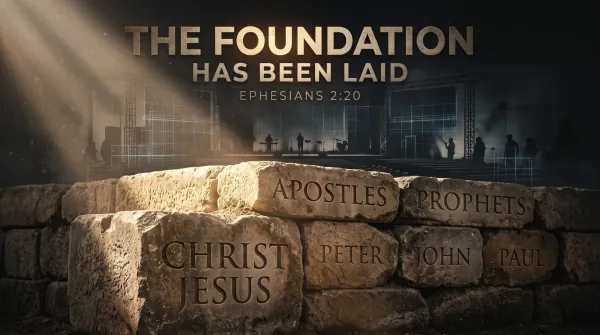
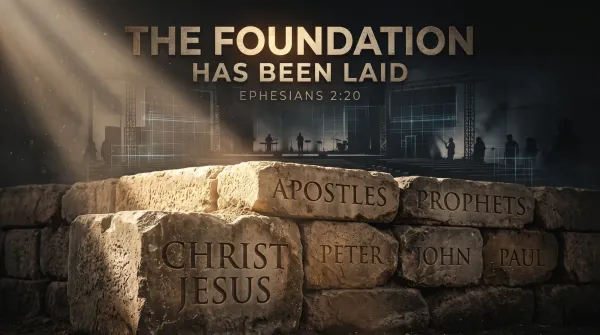
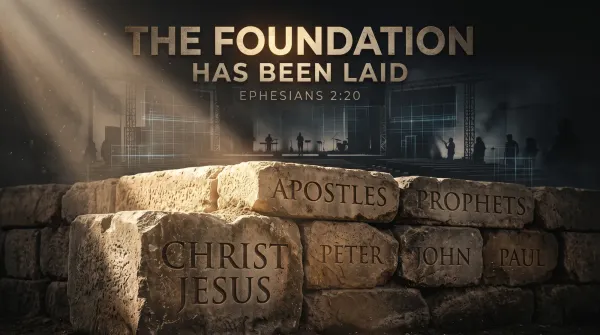
Ephesians 2:20 explicitly defines the church as being built upon "the foundation of the apostles and prophets, with Christ Jesus himself as the chief cornerstone." Think about how a building is constructed. A foundation is laid exactly once at the very beginning of the project; it is not continually poured as the structure goes up.
Once the apostolic era ended, the foundational revelation was complete. Jude 1:3 confirms this, urging believers to contend for the faith that was "once for all entrusted to God’s holy people." The foundational apostolic era is over. I categorically reject the claim that anyone today operates with the authoritative offices of Apostle or Prophet.
Furthermore, while John wrote specifically about his own scroll, historic orthodox theology recognizes that God’s sovereign providence guided the compilation of the Bible. Placing Revelation at the very end of the canon was no accident; it allows John’s localized warning to serve as a fitting, divine seal upon the entire written Word of God.
The Living Word vs. The Written Word
A common deflection from groups like the New Apostolic Reformation (NAR) and Word of Faith is to accuse orthodox believers of "bibliolatry"—claiming we worship a book instead of God.
But Jesus and the Word are inextricably linked. Jesus Christ is the Living Word (Logos), and the Scriptures are the complete, final, and infallible testimony of Him. When Jesus stated that man shall live "on every word that comes from the mouth of God" (Matthew 4:4), He was pointing to the objective, established Scriptures. Who are we to claim that we have received "greater" or "new" revelation beyond the perfectly preserved Word of God? To do so undermines Christ's finished work.
Revelation vs. Illumination: Is the Spirit Silent?
If God isn't giving new revelations, is the Holy Spirit silent? Not at all. The Holy Spirit is intensely active today, but we must understand the critical theological distinction between imparting new truth and applying finished truth.
- Revelation is God disclosing new, authoritative, infallible truth to humanity. This ceased with the closing of the canon.
- Illumination is the Holy Spirit working in believers to help them understand, apply, and be convicted by the already completed revelation of Scripture.
When people say they received a "revelation" from God today that was "good," they are almost always describing illumination, providence, or a subjective personal prompting—not a direct, universally binding edict from the Creator. If it contradicts Scripture, it is false. If it perfectly matches Scripture, it is unnecessary as a new "revelation."
Without the Holy Spirit's active illumination, the Bible is just black ink on white paper to the unregenerate mind (1 Corinthians 2:14). The Spirit does not give us new words; He gives us new eyes to see the depth of the words already given.
The True Ministry of the Holy Spirit
The biblical model of guidance is not hearing a direct, subjective voice dictating our lives. It is the Holy Spirit renewing our minds (Romans 12:2) so we can exercise godly wisdom. He actively sanctifies us, putting our sin to death and producing the Fruit of the Spirit.
J.I. Packer famously described the Holy Spirit's role as a "floodlight ministry." When you look at a beautifully lit cathedral at night, you aren't supposed to look at the floodlight; the floodlight's purpose is to illuminate the building. Jesus said of the Spirit: "He will not speak on his own... He will glorify me" (John 16:13-14). The Holy Spirit does not draw attention to Himself, to new prophets, or to subjective new truths. His active role is to shine a brilliant light entirely upon Jesus Christ as revealed in the Scriptures.
| The Charismatic / NAR Framework | The Biblical / Sola Scriptura Framework |
| The Spirit's Voice: Speaks new, extra-biblical decrees and visions. | The Spirit's Voice: Illuminates and applies the completed written Word. |
| Evidence of the Spirit: Subjective signs, wonders, and new prophecies. | Evidence of the Spirit: Deepened conviction of sin, repentance, and the Fruit of the Spirit. |
| Guidance: "God told me..." (direct, subjective, internal dictation). | Guidance: Wisdom, biblical principles, and providence (a renewed mind). |
| Authority: Man decides if the new revelation is "good" or "false." | Authority: The written Word is the sole, absolute, infallible authority. |
The Gnostic Thread and Doctrines of Demons
This reliance on extra-biblical revelation exposes a dangerous gnostic thread woven deeply into Word of Faith and New Apostolic Reformation teachings. Ancient Gnosticism taught that salvation and spiritual elite status came through gnosis—secret, hidden, higher spiritual knowledge available only to an enlightened few.
When modern "prophets" claim to have fresh revelations and heavenly downloads that the rest of the church lacks, they are resurrecting this ancient heresy. They create a two-tiered Christianity: the enlightened elites who hear directly from God, and the ordinary believers who are told they must rely on these elites for spiritual direction.
By demanding that we accept these extra-biblical, subjective revelations, these movements are allowing what 1 Timothy 4:1 calls "doctrines of demons" to be secretly infused into the church. In a biblical context, "doctrines of demons" does not usually mean horror-movie satanism. Rather, it refers to subtle, deceptive teachings that sound highly spiritual but slowly pull believers away from the sufficiency of Christ and the authority of Scripture. Satan masquerades as an angel of light (2 Corinthians 11:14), and his most effective lies are wrapped in religious language.
What is the ultimate goal of this demonic deception? It is the secret infusion of the deification of man.
This is the rotten core of Word of Faith theology—the idea that believers are "little gods" who can speak reality into existence, just as God does. If man can receive direct, authoritative revelation and independently decree things into being, the boundary between the Creator and the creature is erased. This isn't a new revelation at all; it is the oldest lie in human history, whispered by Satan in the Garden of Eden: "You will be like God" (Genesis 3:5).
Jesus said, "You will know the truth, and the truth will set you free" (John 8:32). That truth is objective, final, and found exclusively in Scripture. No subjective opinion, no matter how spiritual it sounds or who asserts it to be true, will ever provide that freedom. We do not need new revelations; we need the Holy Spirit to help us submit to the perfect revelation we already hold in our hands.
Seeing this red flag in your own congregation? Reach out to us here.
Action Steps:
- Check the Glossary: Visit our NAR Glossary to see if your church is using these redefined terms.
- Compare the Claims: Read our 10 Signs of Church Drift to see if these patterns exist in your congregation.
- Subscribe: Don't Miss a Single Reveal! The unmasking is just beginning. Join over 1,000+ watchmen who receive these deep dives directly in their inbox.
This research is 100% viewer-supported. If this article helped you, consider partnering with our mission to help us keep the lights on.