The Gnostic Thread: A History of NAR Deception and the Digital Architecture of Modern Apologetics
A comprehensive history of NAR deception and the Gnostic roots within modern church movements. Learn how the digital architecture of modern apologetics reshapes theology today. This deep dive examines the "Gnostic Thread" connecting ancient heresy to contemporary apostolic reformation trends.
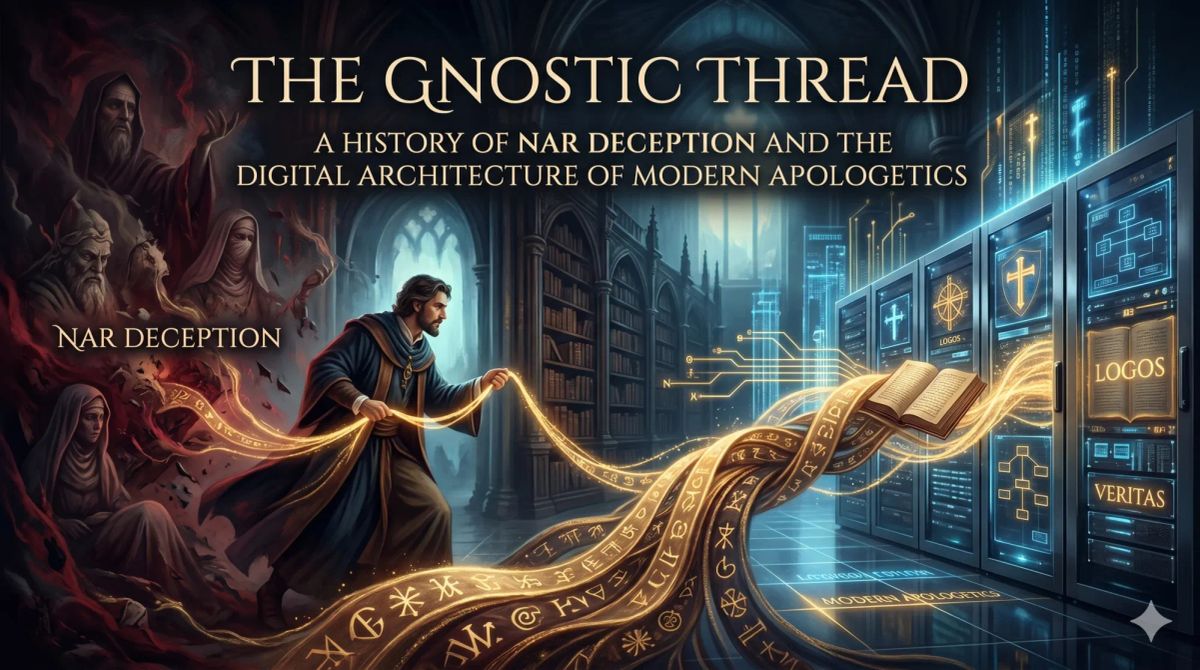
The ecclesiastical landscape of the twenty-first century is currently undergoing a structural transformation that rivals the Reformation of the sixteenth century in scale, if not in theological purity. At the center of this upheaval is a movement known as the New Apostolic Reformation (NAR), a term coined by C. Peter Wagner to describe a "fourth house" of Christendom that seeks to supersede Catholicism, Protestantism, and Orthodoxy.
The Digital Architecture of Modern Apologetics
This movement is defined not by a shared creed or denominational hierarchy, but by a radical ecclesiology that restores the offices of apostle and prophet to the governing center of the church. However, beneath the veneer of revival and "present truth" lies a theological framework that critics argue is a resurgence of ancient Gnosticism, characterized by spiritual elitism, secret knowledge, and a fundamental deconstruction of the nature of Christ.
The persistence of this "Gnostic thread" suggests a historical continuity that connects the second-century heresies refuted by Irenaeus to the modern "apostolic-prophetic" movement. This report provides an exhaustive analysis of the NAR’s theological origins, its characteristic deceptions, and a strategic framework for digital engagement and apologetics. By examining the movement through the lens of church history, systematic theology, and modern digital strategy, the analysis aims to provide a comprehensive guide for those navigating the "Trojan Horse" of modern charismatic extremism.
Defining NAR Deception: A Historical Perspective
The New Apostolic Reformation did not emerge in a vacuum. It is the ideological descendant of several radical charismatic movements that began in the mid-twentieth century. The primary catalyst was the Latter Rain movement of 1948, which emphasized the restoration of the "five-fold ministry" listed in Ephesians 4:11. Central to this period was the ministry of William Branham, whose influence remains the "hidden blueprint" for modern NAR revivalism.
The Influence of William Branham and "The Message"
William Branham is often cited as the father of the post-war healing revivals. His ministry was characterized by an emphasis on "hidden revelation," "spiritual elitism," and "secret knowledge"—themes that are fundamentally Gnostic in character. Branham’s followers, known as "The Message," adopted an indoctrinated apocalyptic theology that viewed Branham as the unique prophetic voice for the end times.
The historical research into Branham’s legacy reveals deep associations with extremist ideologies and a focus on "personal revelation over Scripture".
These elements provided the foundation for the "Manifest Sons of God" theology, which posits that a group of believers will attain a state of perfection and power that allows them to take dominion over the earth before the return of Christ.
C. Peter Wagner and the Institutionalization of the Apostolic
While Branham provided the prophetic fire, C. Peter Wagner provided the academic and institutional framework. As a professor at Fuller Theological Seminary, Wagner transitioned from a focus on traditional church growth to a radical belief in the necessity of modern-day apostles. He argued that the "nuclear church" (the local congregation) must be supplemented by the "extended church," where workplace apostles take dominion in various societal spheres.
| Movement Phase | Key Figures | Primary Doctrine | Impact on Ecclesiology |
| Latter Rain (1948) | William Branham, George Hawtin | Five-fold restoration; Manifest Sons | Break from denominational Pentecostalism |
| Word of Faith (1970s-80s) | Kenneth Hagin, E.W. Kenyon | "Little Gods"; Positive confession | Focus on individual power and wealth |
| Kansas City Prophets (1990s) | Rick Joyner, Mike Bickle | New revelation; Tabernacle of David | Emphasis on continuous prophetic input |
| NAR Institutionalization (2000s) | C. Peter Wagner, Chuck Pierce | Apostolic networks; 7 Mountain Mandate | Shift from evangelism to dominionism |
Wagner’s ecclesiology was inherently trinitarian and missiological, yet it suffered from significant exegetical shortcomings and a reliance on secular models of governance. His strategy involved the aggressive recruitment of independent churches, which were assimilated into apostolic networks through "rapid cytokinesis" or cell-group expansion. In this model, unity is found in the person of the apostle rather than in a shared doctrinal confession.
The Roots of the Gnostic Thread in Modern Theology
The charge of Gnosticism against the NAR is not merely rhetorical but is based on a structural comparison of their theological systems. Historical Gnosticism was a collection of esoteric religious movements that flourished in the second and third centuries, presenting a major challenge to the early church by emphasizing subjective knowledge (gnosis) over objective faith in the person of Jesus Christ.
Gnosis vs. Present Truth
The doctrinal core of Gnosticism is the belief that a "divine spark" exists within man and that salvation is achieved by discovering this internal element through illumination. This subjective knowledge is distinct from biblical revelation because it is not rooted in history or transmitted by the public testimony of the church.
In the NAR, this takes the form of "present truth" or "new revelation." Proponents argue that God is speaking "new things" to apostles and prophets that are not explicitly found in Scripture but are necessary for the church’s end-time mission. This creates a tiered system of believers: those who have the "revelation knowledge" and those who remain in the "darkness" of traditional doctrine.
The Dualism of the Material and Spiritual
A hallmark of Gnosticism is a radical dualism that views physical matter as inferior or evil and the spirit realm as good. While the NAR does not explicitly deny the goodness of creation in the same way as ancient Gnostics, it manifests a functional dualism in its view of the "anointing".
In NAR theology, the "anointing" is often treated as a spiritual substance or "force" that is superior to the physical structures of the church or the human intellect. This leads to an emphasis on spiritual warfare tactics, such as "tearing down strongholds" in the second heaven, which prioritizes spiritual maneuvers over traditional ministry and social engagement.
The Kenotic Heresy: Redefining the Christ
Perhaps the most dangerous theological deviation within the NAR is its redefined Christology, often identified as the "Kenotic Heresy". This doctrine is essential for the movement's focus on human potential and dominion, but it does so by undermining the orthodox understanding of the Hypostatic Union—the union of divine and human natures in the person of Jesus Christ.
The Emptying of Divinity
The NAR teaches that Jesus was "emptied" of His divine nature during His earthly life, living as a mere human who was filled with the Holy Spirit. This view argues that:
- Voluntary Limitation: Jesus did not use His divine attributes while on earth.
- Spirit-Dependent Ministry: Every miracle Jesus performed was done as a man in right relationship with the Spirit, not as God.
- The Template for Believers: Because Jesus did this as a man, any believer who is similarly "anointed" can do the same works and even "greater miracles than Jesus".
This theology "neuters" the Hypostatic Union by suggesting that the divine nature was dormant or inaccessible during the incarnation. Critics argue that if Jesus truly ceased to exercise His divinity, then the Godhead is subject to change, and Jesus’ status as Lord is diminished to that of a "demigod".
The "Little Gods" Doctrine
The logical conclusion of Kenoticism is the "little gods" doctrine. If Jesus attained "deification" or miracle-working power as a mere man through the anointing, then the church can attain the same status. This doctrine posits that believers are "little gods" or "divine sparks" who have the authority to speak things into existence and rule over the physical world.
| Theological Concept | Orthodox View | NAR / Kenotic View |
| The Nature of Christ | Fully God and Fully Man (Simultaneously) | Mere man filled with the Spirit (During incarnation) |
| Source of Miracles | Christ's own divine power and the Spirit | Only the "Anointing" of the Spirit |
| Soteriology | Redemption through Christ's atoning work | Activation of the believer's "divine spark" |
| Human Status | Created beings redeemed by grace | "Little Gods" with inherent creative power |
| Church Authority | Governed by the Word and established elders | Governed by "Apostolic Generals" with new revelation |
By removing the executive control of the divine nature from the human Jesus, the "anointing" effectively becomes the Lord of the life. This shift allows leaders to claim god-like authority over their followers, as they are seen as the primary conduits of this "divine spark".
The Seven Mountain Mandate: A Strategy for Dominion
The theological innovations of the NAR are ultimately directed toward a practical goal: the "Seven Mountain Mandate" (7M). This mandate is a call for Christians to take control of the seven primary pillars of societal influence: government, media, family, business, education, religion, and arts and entertainment.
Origins and Evolution
The concept originated in 1975 with Bill Bright and Loren Cunningham, but it was C. Peter Wagner and Lance Wallnau who transformed it into a dominionist mandate. While it began as a framework for influencing culture with Christian values, it has evolved into a militant strategy for "occupying" these mountains and displacing "demonic strongholds".
Proponents argue that by dominating these spheres, the church will facilitate the return of Christ. This requires "strategic-level spiritual warfare," which involves identifying and "binding" the spiritual principalities that supposedly rule over specific geographic regions or institutions.
How Technology Amplifies New Apostolic Reformation Trends
The 7M mandate has moved from the fringes of charismatic theology into the center of political discourse. NAR leaders such as Lance Wallnau and Dutch Sheets have been vocal supporters of specific political figures, often describing them as "anointed" by God to reclaim the mountain of government. This "spiritual militancy" blurs the line between faith and authoritarianism, framing political participation as a cosmic battle between good and evil.
| Mountain | Sphere of Influence | NAR Objective |
| Religion | Theology and Church Practice | Replace traditional denominations with NAR networks |
| Government | Law and Policy | Install "apostolic" leaders and biblical law |
| Education | Curriculum and Pedagogy | Reclaim schools from "secular humanism" |
| Media | Narrative and News | Control the flow of information to align with "kingdom values" |
| Business | Wealth and Economics | Wealth transfer for kingdom projects |
| Family | Core Societal Unit | Redefine family structures under apostolic guidance |
| Arts & Ent. | Cultural Imagination | Infuse culture with "anointed" art and media |
The NAR’s approach to dominionism is often described as "Charismatic Reconstructionism," mirroring the goal of the older Christian Reconstructionist movement to establish a country governed by a specific interpretation of biblical law.
Irenaeus Against the Modern Heretics: Apostolic Tradition as the Antidote
To combat the Gnostic errors of the second century, Irenaeus of Lyon wrote Against Heresies (Adversus Haereses), a five-volume work that remains the definitive refutation of esoteric Christianity. His arguments provide a critical roadmap for modern believers facing the deceptions of the NAR.
The Rule of Faith vs. Secret Revelation
Irenaeus argued that the "apostolic tradition" was not a secret, unwritten teaching available only to an elite few. Instead, it was the public, universally held faith that had been handed down from the apostles to the bishops of the church. He contended that:
- Public Consistency: The true doctrines of the faith are identical in every church throughout the world.
- Scriptural Finality: The apostles preached the Gospel first and only later handed it down in the Scriptures to be the "ground and pillar of our faith".
- Public Succession: If the apostles had known "hidden mysteries," they would have delivered them to the people they entrusted with the leadership of the churches.
The Defense of the Material and the Incarnation
Against the Gnostic depreciation of matter, Irenaeus insisted on the goodness of the material creation and the necessity of the physical incarnation and bodily resurrection of Jesus. He argued that the physical body of the believer is not a hindrance to spiritual growth but is the very temple of the Holy Spirit, destined for resurrection.
Identifying Gnostic Influence in Today’s Online Discernment
This stands in stark contrast to the NAR’s reliance on "new truths" and "revelation knowledge" that are supposedly being revealed for the first time in centuries. For Irenaeus, any teaching that contradicted the public, written word was "knowledge falsely so-called".
The NAR’s focus on "spiritual warfare" in the heavenly realms often leads to a neglect of the physical and historical realities of the faith. By re-anchoring theology in the historic incarnation, Irenaeus provides a corrective to the "mystical opacity" of modern apostolic-prophetic movements.
Reclaiming Truth in an Age of Digital Deception
Reclaiming truth requires more than just identifying error; it demands a return to a theology that is grounded in history rather than high-speed algorithms. As we navigate the complexities of the digital architecture, we must decouple our faith from the sensory-driven "Gnostic Thread" and the shifting authorities of NAR deception. By anchoring our discernment in the objective, unchanging Word of Christ, we can bypass the noise of modern apologetics and find a clarity that is neither branded nor broadcast, but eternally true. Our defense of the faith must ultimately be as solid as the foundations of the ancient church, standing firm against the ephemeral deceptions of the digital age.
Ground Your Faith in Truth
Don’t navigate the complexities of modern apologetics alone. Join our community to receive deep-dive investigations, historical analysis, and biblical tools for discerning NAR deception in the digital age.