Shepherds or Strategists? How TPUSA’s Pastors Summit Reframes Ministry as Political Mobilization
TPUSA’s Pastors Summit presents political activism as pastoral courage. This article examines how church leadership can shift from shepherding souls to mobilizing blocs.

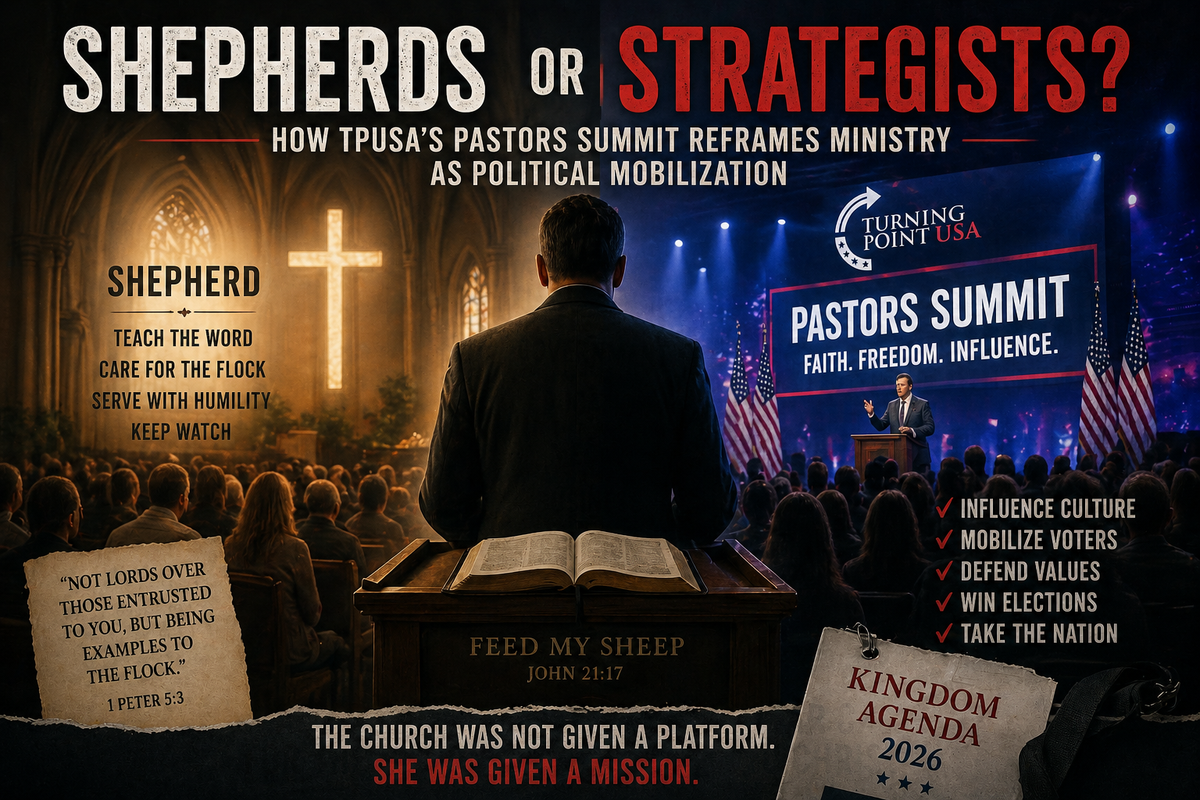
Across American politics, few institutions carry as much local trust and relational influence as the church.
Pastors counsel families, bury the dead, comfort the grieving, teach Scripture, mentor youth, and shape the moral imagination of communities. That makes them valuable not only to congregations—but also to political movements seeking durable grassroots power.
It is no surprise, then, that Turning Point USA has invested in events designed specifically for clergy and church leaders.
The stated purpose is often courage, engagement, and defending values.
But beneath that language lies a more pressing question:
Are pastors being equipped to shepherd souls—or organized to mobilize voting blocs?
Why Pastors Matter to Political Movements
A pastor often has what campaigns cannot easily buy:
- weekly access to trusting audiences
- moral credibility
- multigenerational relationships
- volunteer networks
- communication platforms
- local legitimacy
When movements seek pastors, they are not merely seeking endorsements.
They are seeking infrastructure.
The New Vocabulary of Political Ministry
Modern church-political events rarely present themselves as raw partisanship. Instead, they use morally charged language:
- stand for truth
- defend freedom
- protect families
- be bold
- refuse silence
- lead courageously
Again, none of these phrases are inherently wrong.
The concern is what happens when biblical language becomes a delivery system for partisan objectives.
When that occurs, ministry can slowly be redefined around elections, narratives, and enemies rather than prayer, doctrine, repentance, and care.
Shepherding vs. Strategy
The New Testament repeatedly describes leaders as shepherds.
A shepherd knows the flock, guards the vulnerable, teaches sound doctrine, corrects gently, and models holiness.
A strategist asks different questions:
- How do we increase turnout?
- Which issues motivate people most?
- What messaging creates urgency?
- How do we defeat opponents?
- Which alliances maximize influence?
Strategy has a place in organizations.
But when shepherds begin thinking primarily as strategists, the flock often becomes an audience—and souls become assets.
Theological Hook: Institutional Capture vs. the Kingdom of God
Some modern movements assume that if Christians can gain enough leverage inside institutions, renewal will follow.
That is the logic of institutional capture:
- capture school boards
- capture legislatures
- capture media narratives
- capture party machinery
- capture cultural platforms
But Christ described a different kingdom.
The Kingdom of God does not arrive through coercive dominance or bloc control. It grows like seed, yeast, witness, mercy, repentance, and transformed lives.
Political participation can be wise and necessary.
But when churches are taught to see power as the primary engine of renewal, they risk forgetting how the Kingdom actually advances.
What Congregations Often Experience
When pastors absorb movement logic, churches can subtly change.
Sermons become commentary.
Prayer requests become talking points.
Members become demographics.
Neighbors become enemies.
Faithfulness becomes outrage.
Discipleship becomes alignment.
Many members cannot immediately name what changed.
They simply sense that something once centered on Christ is now orbiting politics.
Why This Appeals to Leaders
Many pastors feel real pressure:
- declining attendance
- cultural hostility
- legal uncertainty
- moral confusion among youth
- congregational division
- loss of social influence
Political summits often offer what feels like clarity: urgency, allies, messaging, momentum, and a visible mission.
That can be deeply attractive to tired leaders.
But urgency is not the same thing as wisdom.
Questions Church Members Should Ask
If leaders attend politically oriented pastor events, thoughtful questions matter:
- Is Scripture driving priorities, or headlines?
- Is the church becoming more prayerful or more reactive?
- Are people being discipled or activated?
- Are opponents described as neighbors or enemies?
- Is courage defined as holiness—or constant confrontation?
These are not anti-political questions.
They are pro-church questions.
The Better Vision for Pastoral Leadership
Pastors need courage—but not only the courage to speak publicly.
They also need courage to:
- resist flattery from power brokers
- disappoint partisan expectations
- preach unpopular truths to every side
- prioritize prayer over relevance
- protect unity without compromising conviction
- remain ordinary shepherds in an age of celebrity
That kind of courage rarely trends.
But it builds healthy churches.
Final Thought
Political movements naturally seek pastors because pastors possess trust, networks, and influence.
The church should understand that reality clearly.
A pastor may engage civic life responsibly. But when ministry is reframed as movement strategy, something sacred is reduced to utility.
The calling of a shepherd is not to become a precinct captain with a Bible verse.
It is to care for souls under the authority of a King whose Kingdom is not of this world.
Seeing this red flag in your own congregation? Reach out to us here.
Action Steps:
- Check the Glossary: Visit our NAR Glossary to see if your church is using these redefined terms.
- Compare the Claims: Read our 10 Signs of Church Drift to see if these patterns exist in your congregation.
- Subscribe: Don't Miss a Single Reveal! The unmasking is just beginning. Join over 1,000+ watchmen who receive these deep dives directly in their inbox.
This research is 100% viewer-supported. If this article helped you, consider partnering with our mission to help us keep the lights on.