Elijah vs. the Prophets of Baal: The Epic Showdown at Mount Carmel
It wasn’t just a religious debate; it was a high-stakes cultural war. From Queen Jezebel’s state-sponsored revolution to Elijah’s defiant fire on Mount Carmel, discover the explosive power struggle that redefined the soul of ancient Israel.

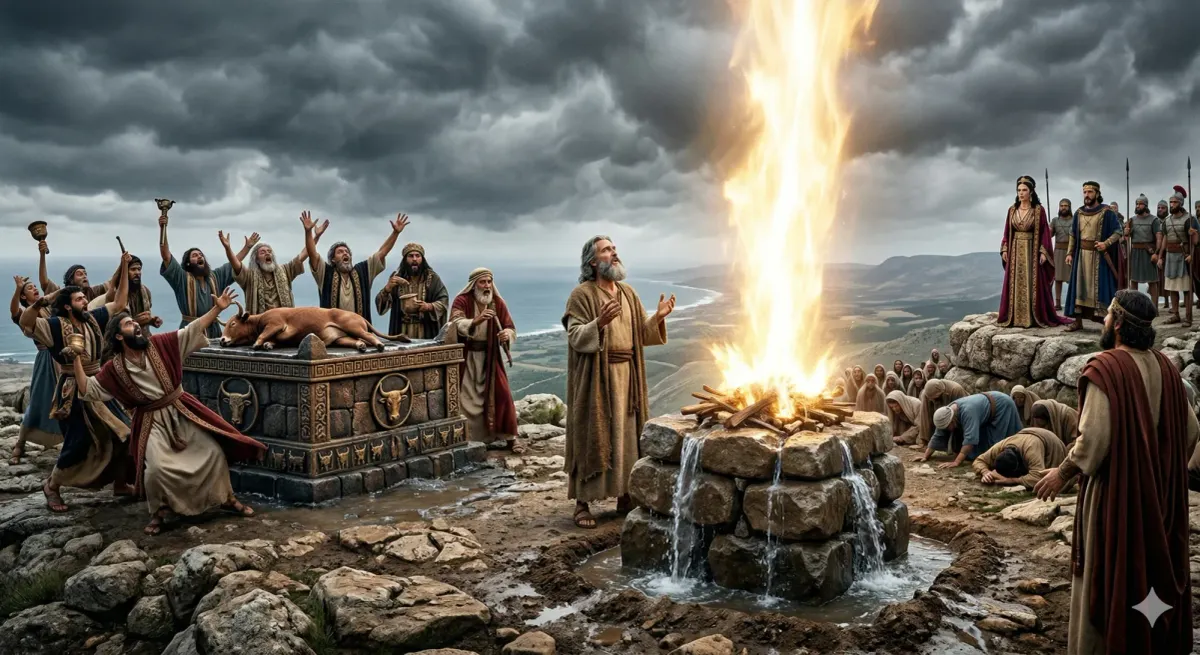
The story of Jezebel and the prophets of Baal is one of the most dramatic power struggles in the Hebrew Bible. It isn't just a religious conflict; it’s a political and cultural war between the traditional worship of Yahweh and the imported Phoenician worship of Baal.
The Architect: Jezebel’s Influence
Jezebel was a Phoenician princess, the daughter of Ethbaal, King of Sidon. When she married King Ahab of Israel, she didn't just join his court; she effectively transformed it.
- Religious Revolution: She moved to replace the worship of Yahweh with the worship of Baal (the Canaanite storm god) and Asherah (a fertility goddess).
- Systemic Persecution: Jezebel was not a passive queen. She actively funded 450 prophets of Baal and 400 prophets of Asherah from the royal treasury while systematically hunting down and killing the prophets of Yahweh.
The Protagonist: Elijah the Tishbite
Standing against Jezebel’s state-sponsored religion was the prophet Elijah. To prove whose god was supreme, Elijah proposed a spiritual "duel" on Mount Carmel.
The Showdown at Mount Carmel
The challenge was simple: two altars, two bulls, but no fire. The god who answered by sending fire from the sky to consume the sacrifice would be recognized as the true God.
1. The Prophets of Baal
The 450 prophets of Baal went first. They prayed, danced, and even cut themselves (a common ritual practice of the time) from morning until evening. Elijah, showing his characteristic wit, taunted them, suggesting that perhaps Baal was busy, traveling, or sleeping. Despite their frenzy, "there was no voice; no one answered."
2. Elijah’s Turn
To make the demonstration even more impossible, Elijah had his altar drenched with twelve large jars of water until a trench around it was overflowing.
- The Result: Elijah prayed a simple prayer. According to the text, fire fell from heaven immediately, consuming the sacrifice, the wood, the stones, the soil, and even licking up the water in the trench.
- The Aftermath: The watching crowd fell prostrate, crying, "The Lord, he is God!" Elijah then ordered the execution of the 450 prophets of Baal at the Kishon Valley.
The Fallout and Legacy
While Mount Carmel was a massive theological victory, it didn't end the political strife.
- Jezebel’s Fury: Rather than being humbled, Jezebel was incensed by the execution of her prophets. She sent a messenger to Elijah promising to kill him within 24 hours, sending the prophet into a famous bout of fear and exhaustion in the wilderness.
- The End of the Line: Years later, the conflict concluded with the rise of Jehu, a military commander. Following the prophecy of Elisha (Elijah's successor), Jehu staged a coup. Jezebel met a violent end—thrown from a palace window—marking the end of the Omride dynasty and the official state-sanctioned worship of Baal in Israel.
Key Themes
The story remains one of the most potent examples in literature of the clash between two irreconcilable worldviews. Do you see any modern parallels today?
Seeing this red flag in your own congregation? Reach out to us here.
Action Steps:
- Check the Glossary: Visit our NAR Glossary to see if your church is using these redefined terms.
- Compare the Claims: Read our 10 Signs of Church Drift to see if these patterns exist in your congregation.
- Subscribe: Don't Miss a Single Reveal! The unmasking is just beginning. Join over 1,000+ watchmen who receive these deep dives directly in their inbox.
This research is 100% viewer-supported. If this article helped you, consider partnering with our mission to help us keep the lights on.