Biblical Womanhood or Political Branding? How TPUSA Markets Identity to Young Christian Women
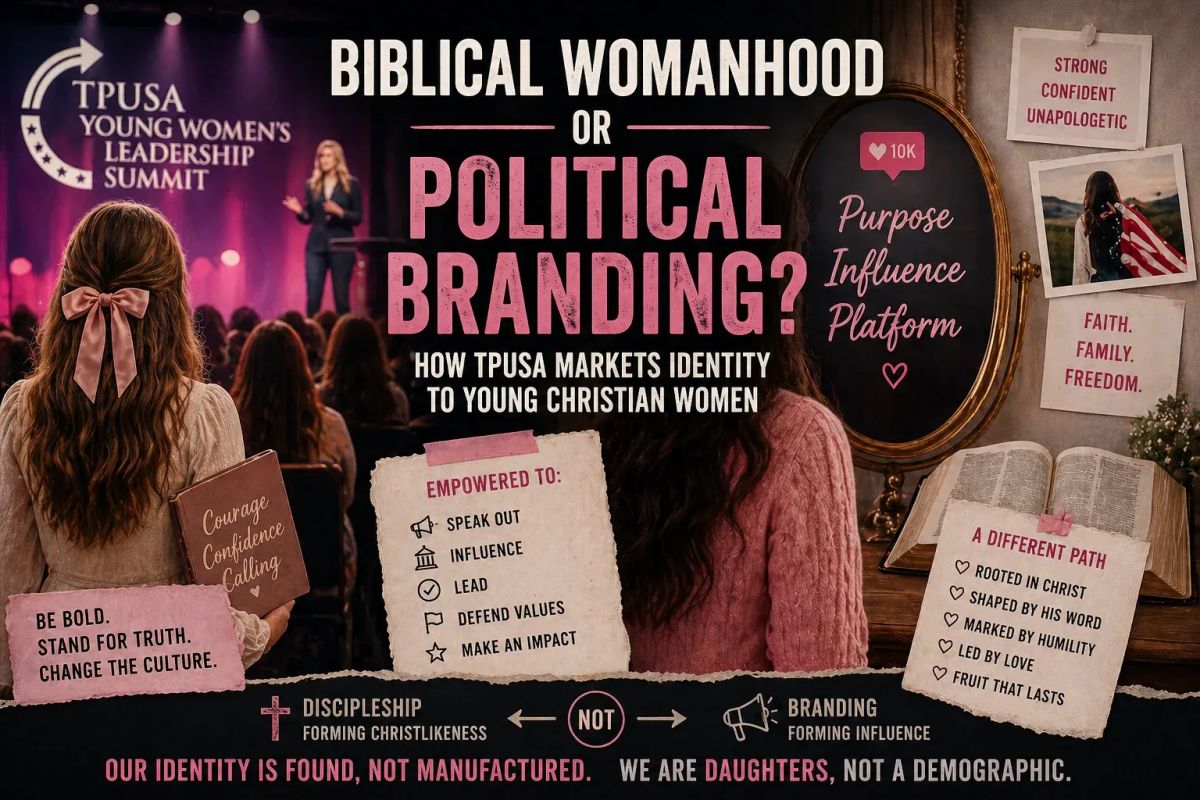
TPUSA women-focused events often package politics as purpose for young Christian women. This article explores how empowerment language can mask partisan identity formation more than biblical discipleship.

Across the United States, Turning Point USA has increasingly recognized a strategic reality: young women are not only cultural participants—they are cultural multipliers.
They shape trends, social norms, campus conversations, online communities, and future families. That makes them a vital audience for any movement seeking long-term influence.
So it is no surprise that TPUSA has invested in women-focused leadership spaces that blend confidence, femininity, faith language, and political activism into a single aspirational package.
The question is not whether young women should lead.
The question is what they are being formed to become.
The New Messaging: Confidence, Courage, and Calling
Modern political outreach rarely uses blunt ideological language. Instead, it speaks in the language of identity and purpose.
At women-focused events, the messaging often sounds like this:
- Be bold
- Stand for truth
- Reject cultural lies
- Use your voice
- Defend family values
- Lead with conviction
None of those phrases are inherently wrong. In fact, many sound admirable.
But when these ideas are embedded inside a partisan ecosystem, they can become a pathway where political identity is mistaken for spiritual calling.
Rebranding Old Gender Politics as Empowerment
Historically, some conservative Christian spaces framed womanhood in terms of submission, modesty, domestic order, and support roles.
That language has limited appeal to younger generations shaped by entrepreneurship, influence culture, and digital visibility.
So the messaging evolves.
Instead of restraint, the theme becomes strength.
Instead of silence, platform.
Instead of support role, influencer leadership.
Instead of obedience, impact.
The result is a more modern packaging of older assumptions—one that feels empowering while still channeling women toward predetermined political outcomes.
Discipleship or Recruitment?
There is an important distinction between spiritual formation and ideological mobilization.
Christian discipleship asks:
- Am I becoming more like Christ?
- Am I growing in humility?
- Do I love truth and mercy?
- Is my character deepening?
- Am I serving others faithfully?
Political recruitment asks:
- Am I on the right side?
- Am I winning arguments?
- Am I visible enough?
- Am I helping defeat opponents?
- Am I useful to the movement?
When conferences blur those categories, students may confuse applause with calling.
Created Identity vs. Manufactured Identity
Scripture roots identity in being created by God and redeemed in Christ.
That identity is received, not branded.
It is cultivated through repentance, wisdom, prayer, community, sacrifice, and obedience—not through slogans, merch, applause, or algorithmic relevance.
Manufactured identity works differently. It tells young people:
- your worth is influence
- your mission is visibility
- your courage is confrontation
- your community is the movement
- your purpose is political victory
That framework can feel powerful in the short term while leaving the soul shallow in the long term.
Why Young Women Are Especially Targeted
Young women often carry social credibility that movements want to leverage.
They can soften harsh rhetoric, normalize controversial positions, expand audience reach, and embody a more attractive public image.
When a movement places polished young women at the center of branding, it often signals a strategy deeper than representation.
It signals persuasion.
What Parents, Pastors, and Mentors Should Ask
If a student attends one of these events, ask thoughtful questions:
- Was Christ central, or merely referenced?
- Was character emphasized more than influence?
- Were humility and service praised, or only boldness and visibility?
- Were opponents treated with dignity?
- Was womanhood rooted in discipleship or in branding?
These conversations matter more than outrage.
The Better Vision
Young Christian women do not need to choose between passivity and political performance.
There is a better path:
- wisdom without cynicism
- courage without vanity
- conviction without cruelty
- leadership without branding
- influence without idolatry
- strength shaped by love
The church should be forming women of depth, holiness, intelligence, compassion, and resilience—not simply producing polished surrogates for political causes.
Final Thought
When activism is marketed as identity, many students will mistake movement energy for meaning.
But no conference can bestow what only God can give.
The deepest calling of a Christian woman is not to become a symbol for a cause.
It is to become faithful in the Kingdom of God.
Seeing this red flag in your own congregation? Reach out to us here.
Action Steps:
- Check the Glossary: Visit our NAR Glossary to see if your church is using these redefined terms.
- Compare the Claims: Read our 10 Signs of Church Drift to see if these patterns exist in your congregation.
- Subscribe: Don't Miss a Single Reveal! The unmasking is just beginning. Join over 1,000+ watchmen who receive these deep dives directly in their inbox.
This research is 100% viewer-supported. If this article helped you, consider partnering with our mission to help us keep the lights on.