Faith, Family, and Freedom? How TPUSA’s ‘Faith Night’ Repackages Seven Mountain Theology for Gen Z
TPUSA’s February 2026 Faith Night in Redding framed “faith, family, and freedom” for students, but echoed Seven Mountain Mandate themes. This article contrasts political altar calls for the nation with the gospel call to personal repentance.

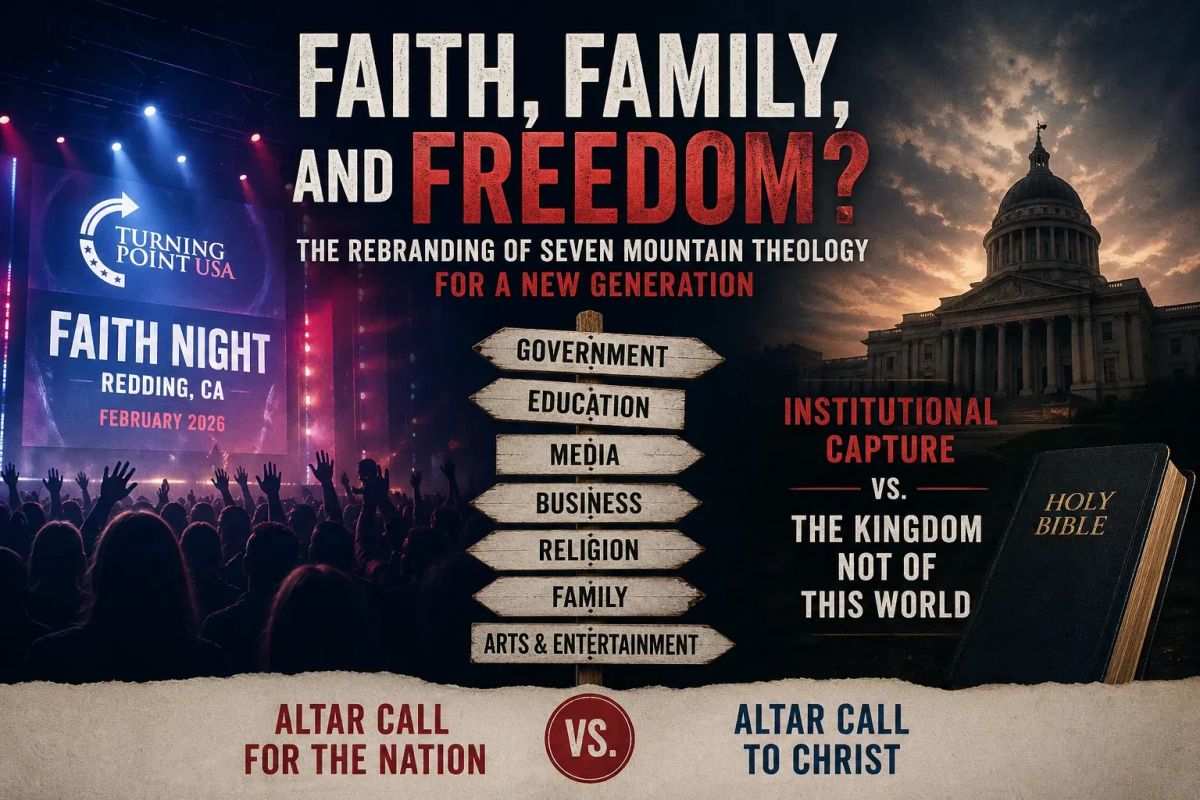
In February 2026, Turning Point USA hosted a “Faith Night” in Redding, California—a city already known in many Christian circles for charismatic revival culture and networks associated with dominion-oriented theology. On the surface, the branding sounded familiar and harmless: faith, family, and freedom.
But beneath the polished language lies a pattern many parents, pastors, and students should recognize: the repackaging of Seven Mountain Mandate ideas for a younger generation.
This is not merely a shift in vocabulary. It is a shift in discipleship.
From Seven Mountains to “Faith, Family, and Freedom”
The Seven Mountain Mandate teaches that Christians are called to take control of seven spheres of society—typically government, media, education, business, religion, family, and arts/entertainment. While versions differ, the common thread is that cultural transformation comes through strategic institutional influence.
That language can sound too overtly triumphalist for Gen Z audiences who are skeptical of power, branding, and old religious slogans. So instead of talking about “taking mountains,” newer movements often emphasize softer language:
- Faith = spiritual legitimacy
- Family = moral urgency
- Freedom = political mobilization
This rhetorical reframing allows dominion-oriented politics to sound like values advocacy rather than power theology.
To younger listeners, it can feel less like a hierarchy project and more like a cause-driven movement.
The “Altar Call for the Nation”
One of the more revealing features of these events is the use of revival language in political settings.
Historically, an altar call in evangelical tradition invites individuals to respond to the gospel through repentance, faith in Christ, surrender, reconciliation, or renewed obedience. It centers on the condition of the heart before God.
But at events like Faith Night, the altar call often becomes something else: an altar call for the nation.
Instead of:
- Repent of sin
- Be reconciled to God
- Trust in Christ
- Receive grace
The call becomes:
- Take back the culture
- Save the country
- Win the institutions
- Mobilize politically
That substitution matters.
When national destiny replaces personal repentance, the language of salvation is redirected from the soul to the state.
Institutional Capture vs. The Kingdom Not of This World
There is a profound theological contrast here.
One vision says transformation comes through institutional capture—gaining leverage over schools, governments, media systems, and cultural platforms.
The other comes from Christ’s own words:
“My kingdom is not of this world.”
The New Testament model of influence is not domination but witness. Not seizure of institutions but faithfulness within them. Not conquest through power blocs, but sacrificial love, truth, holiness, and perseverance.
Christians certainly serve in politics, education, business, and the arts. But service is different from capture.
The church loses something vital when it begins to believe the kingdom advances primarily through control rather than conversion.
Why This Appeals to Students
Many students want meaning, mission, and courage. They see cultural confusion and want clarity. They feel institutions are broken and want change.
That desire is understandable.
But movements built on urgency can redirect youthful zeal toward political identity rather than spiritual maturity.
Students may be taught:
- activism before prayer
- enemies before neighbors
- power before character
- victory before repentance
That is not discipleship. It is recruitment with worship music.
What Parents and Campus Leaders Should Ask
If your student attends a political-faith event, ask:
- Was the gospel clearly presented, or was America the center of the message?
- Were students called to holiness, or mainly to activism?
- Was political power framed as the path to renewal?
- Were opponents treated as people to love or enemies to defeat?
- Did Christ’s kingdom remain distinct from partisan agendas?
These questions matter because rhetoric shapes imagination.
Final Thought
“Faith, family, and freedom” can sound noble. But slogans often conceal deeper frameworks.
When Seven Mountain ideas are repackaged for a younger demographic, students may not realize they are being invited into a theology of power rather than a theology of the cross.
The church does not need institutional capture to be faithful.
It needs courage, repentance, truth, and allegiance to a King whose kingdom is not of this world.
Seeing this red flag in your own congregation? Reach out to us here.
Action Steps:
- Check the Glossary: Visit our NAR Glossary to see if your church is using these redefined terms.
- Compare the Claims: Read our 10 Signs of Church Drift to see if these patterns exist in your congregation.
- Subscribe: Don't Miss a Single Reveal! The unmasking is just beginning. Join over 1,000+ watchmen who receive these deep dives directly in their inbox.
This research is 100% viewer-supported. If this article helped you, consider partnering with our mission to help us keep the lights on.