Sound Check: How to Spot New Age Influence in Modern Worship Music
Swelling pads and catchy bridges often hide subtle shifts in theology. From "shifting atmospheres" to "manifestation," here is how to spot New Age influence in modern worship anthems.

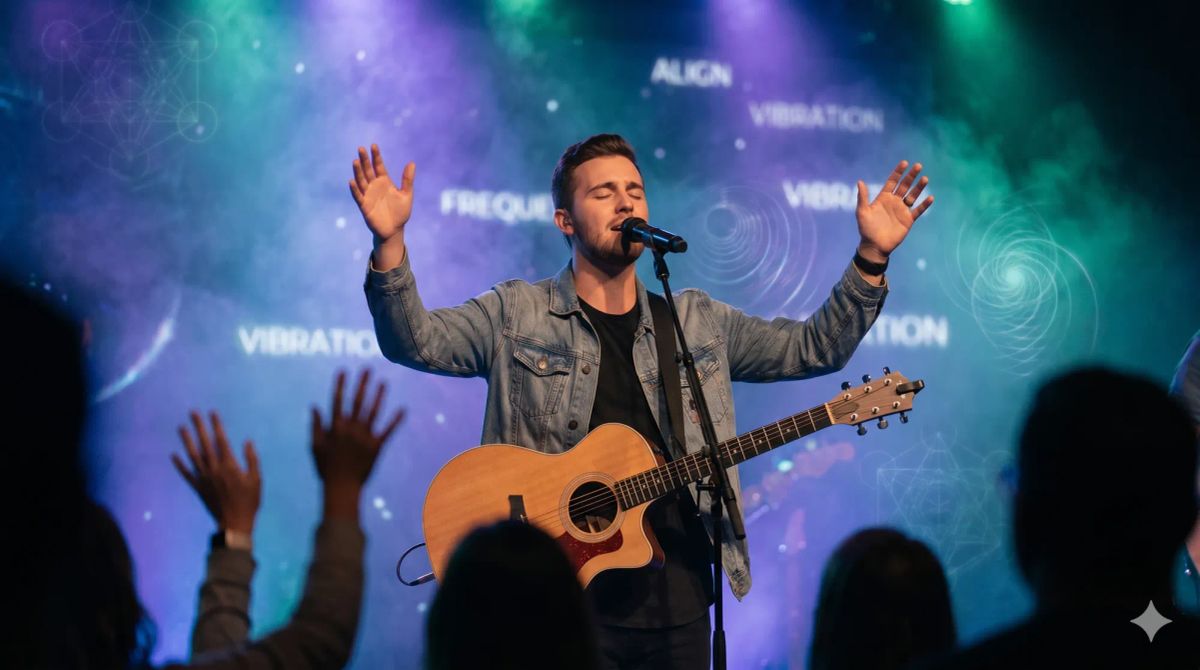
Walk into almost any modern evangelical church today, and the worship experience is undeniable. The lights are low, and the music is designed to pull you into a deep emotional space. For the most part, modern worship has given the global church a beautiful vocabulary for praise.
But if you listen closely to the lyrics drifting through some of our most popular worship anthems, you might notice a subtle shift. Over the last decade, a new vocabulary has crept into the church. It doesn’t usually announce itself with blatant heresy; instead, it sneaks in on the back of beautiful melodies.
Suddenly, songs sound less like King David crying out to the Holy One of Israel and more like a wellness retreat speaker trying to align their chakras.
If you want to guard your mind and keep your worship rooted in truth, here are four red flags to help you spot New Age influence in modern worship music.
1. The Obsession with "Atmospheres" and "Energy"
In the New Age worldview, everything is energy, and spiritual growth is about learning to manipulate the "vibe" or atmosphere around you. Unfortunately, this language has heavily bled into modern songwriting.
What to look for:
- Lyrics that command the "atmosphere to shift" or focus entirely on changing the "climate" of the room.
- Songs that treat the presence of God like a physical thermodynamic force that we can generate through high-energy singing.
The Biblical Reality Check: The Holy Spirit is a Person, not an atmospheric condition. He does not need our permission to enter a room, nor is He summoned by a perfectly mixed minor chord. In scripture, when God’s presence falls, humans fall on their faces in repentance (Isaiah 6)—they don't try to manage the room's energy.
2. "Vibrational" Language: Frequencies and Portals
This is a direct cousin of the "Quantum Faith" movement. New Age spirituality teaches that the universe responds to specific sound frequencies that can unlock higher consciousness.
What to look for:
- Songs that talk about "sounding a frequency," "releasing a sound that unlocks the heavens," or "opening up portals."
- An emphasis on the sound itself having a functional power to heal or alter reality, independent of the gospel message.
The Biblical Reality Check: Music is a beautiful medium for expressing praise, but sound waves carry no inherent spiritual power to unlock God's blessings. The only "portal" or access we have to the Father is the torn veil—the broken body and shed blood of Jesus Christ (Hebrews 10:19-20). Our access is relational and covenantal, not acoustic.
3. Turning Worship into "Manifestation"
One of the core tenets of the New Age "Law of Attraction" is manifestation—using your words and thoughts to attract your desires from the universe. In modern worship, this often looks like songs that spend more time talking to our problems than talking to God.
What to look for:
- Songs dominated by "I decree," "I declare," or "I speak to the dry bones."
- Lyrics that position the believer as the primary active force, commanding the environment to line up with their words.
The Biblical Reality Check: While there is a time for speaking truth to our souls (like David in Psalm 42:5), worship is fundamentally vertical. True worship is an occupation with the attributes and actions of God. When a worship song becomes a three-minute exercise in commanding our circumstances to bow to our declaration, we have subtly traded worship for manifestation.
4. Blurring the Line Between Creator and Creation (Panentheism)
New Age thought teaches panentheism—the belief that God is in everything and everything is a part of God. This leads to a blurring of the lines between who God is and who we are.
What to look for:
- Lyrics that imply God is "the wind in my sails" or an all-enveloping cosmic energy, rather than a Holy, transcendent King.
- Songs that focus so heavily on our internal divinity or "oneness" with the cosmos that the concepts of sin, repentance, and holiness are entirely erased.
The Biblical Reality Check: God is entirely separate from His creation. He is holy, which literally means set apart. Colossians 1:16-17 tells us that all things were created by Him and for Him, and in Him all things hold together—but creation is not God. Worship must maintain the beautiful, humble distinction that He is the Master, and we are the redeemed.
Guard Your Ears, Guard Your Heart
Music has a unique back-door pass into our theology. We might forget the points of a sermon by Tuesday, but we will hum a catchy bridge all week long. That means the songs we sing are actively shaping what we believe about God.
The next time you find yourself singing along to the latest hit worship track, take a moment to look past the emotional swell of the bridge. Ask yourself: Is this song pointing me to the crucified and risen Christ, or is it asking me to manage a spiritual ecosystem? Keep your theology sharp, and let your worship be a pure response to the truth of God's Word.
Seeing this red flag in your own congregation? Reach out to us here.
Action Steps:
- Check the Glossary: Visit our NAR Glossary to see if your church is using these redefined terms.
- Compare the Claims: Read our 10 Signs of Church Drift to see if these patterns exist in your congregation.
- Subscribe: Don't Miss a Single Reveal! The unmasking is just beginning. Join over 1,000+ watchmen who receive these deep dives directly in their inbox.
This research is 100% viewer-supported. If this article helped you, consider partnering with our mission to help us keep the lights on.